
That’s not a plat map. That’s my family’s legacy.
To outsiders, it may look like acreage on a map. To a farm family, it is history, sacrifice, memory, and the responsibility of deciding what gets passed on next.
When land is more than land
Recently in my hometown of Hillsboro, Ohio, there was a public forum about a new lithium battery storage facility. The energy company brought in representatives, gave their canned responses, and showed where the 35-acre facility would sit on a plat map.
To them, it was just a map showing farmland in a small southern Ohio farm town. To me, that was my family’s legacy.
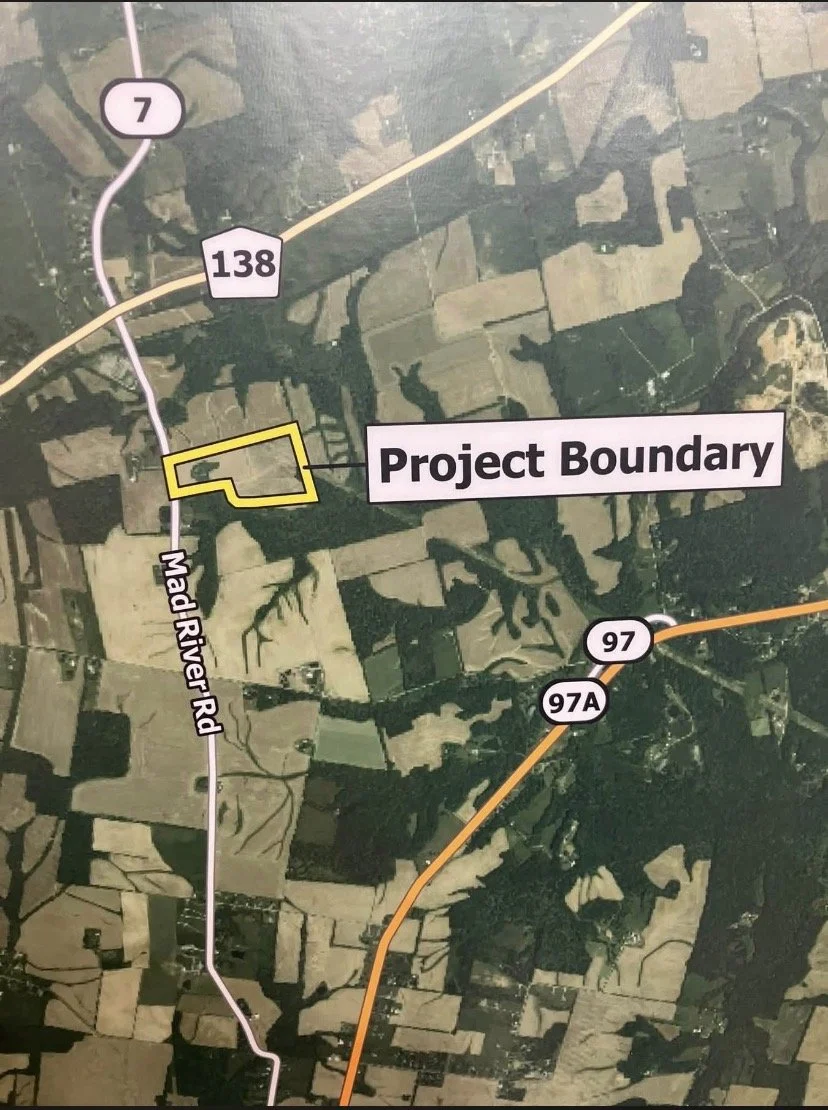
The farm behind the map
My family’s farm surrounds that proposed facility. From the plat map, it just looks like fields from a 10,000-foot view. But from that map, I can point out the places that shaped my life.
That farm is the one my grandpa bought when he became a doctor in town. He and my grandma returned to that same Ohio dirt.
My father busted his butt his whole life to keep the farm running and not lose it to the bank or Uncle Sam.
That creek running through it is where I spent my childhood thinking I was Davy Crockett, exploring the woods and catching crawdads.
Back that long lane is the location of generations of truck bed date nights. That field is where Dad turned me loose on the old 6080 raking hay when I still had to scoot to the edge of the seat just to push in the clutch.
“That’s good money. Better than I can do farming. But what kind of legacy would that leave?”
A neighboring farmer said it perfectly. Sometimes the financial offer is obvious. The legacy question is harder.The financial moat around the family farm
Those suits do not understand the tie farming families have to their land. It is more than an occupation. It is more than a place where you pick up the mail. It is legacy.
When I got in my accident, I went to school for business and accounting because I did not think I could help the farm from a wheelchair. Man, was I wrong.
Today, the mission is clear: build a financial moat around not only my family’s legacy, but around family farms and ranches across the country.
Four priorities that help protect the farm
Vision
Where do you want the operation to be one year from now, and one generation from now? If the vision only lives in your head, it becomes harder to protect when pressure hits.
Know Your Numbers
Clean books, updated cash flow, balance sheets, and profit and loss statements help you make decisions before tax season tells you what already happened.
Tax Planning
Buying equipment at year-end is not a full tax plan. The goal is not to eliminate taxes for one year. The goal is to minimize taxes over a lifetime.
Succession Planning
Fair does not always mean equal. The hardest question is often how the on-farm heirs can continue the operation while treating off-farm heirs with care.
Vision: where is this operation going?
Proverbs 29:18 says, “Where there is no vision, the people perish: but he that keepeth the law, happy is he.”
Having a clear vision and core principles may sound like the soft stuff, especially when there is a long list of urgent work, late bills, and money already spent before the grain check hits the bank. But without direction, hard seasons can make you question if the juice is worth the squeeze.
Do not let the vision stay trapped in your head. And do not let “that is how we have always done it” become the plan.
Know your numbers: stop being a checkbook balance farmer
Financial statements are not only important once a year when you go to the bank to renew your line of credit.
Without up-to-date cash flow, balance sheets, and profit and loss statements, it is easy to fall into the habit of becoming a checkbook balance farmer. You know the balance in the checkbook register, hope it is positive at year-end, and do not really know whether you made anything until your taxes come back from the accountant.
Clean books and updated financials allow you to make informed decisions about your operation. They help you see whether your “cash cow” is actually a broke-mouthed cow that needs culled.
Tax planning: do not leave Uncle Sam a tip
Taxes are often considered a dirty four-letter word, and anyone who likes paying them is sick in the head.
Paying taxes is not always the worst thing. But when you pay your tax bill, do not leave Uncle Sam a tip.
In a good year, farmers are often told to buy equipment or a pickup truck before year-end or they will have to pay taxes. That can make sense in the right context, but calling that a full tax plan is weak.
The goal of tax planning is not to eliminate taxes for one year. It is to use the tax code to minimize your tax bill over your lifetime.
Succession planning: fair does not always mean equal
The toughest part of farm financial planning is deciding what happens to the farm after you are gone. It is not one size fits all.
The biggest obstacle is determining what is fair for everyone involved. That does not always mean equal.
If equal were the only goal, you could sell out to a solar project, data center, or outside buyer, take what is left after the IRS gets its cut, and split the money. But statistically, that wealth is often gone within two generations.
That leads to the harder question: how will the on-farm heirs buy out the off-farm heirs?
Without a plan, families often face painful alternatives: dividing ground into pieces that kill the operation’s margin, borrowing against land that took generations to pay off, or leaving behind family conflict that lasts long after Mom and Dad are gone.
Protecting the farm takes more than hard work.
It takes vision, clean numbers, tax planning, and a succession strategy that respects both the land and the people tied to it.
Schedule a Farm Legacy Planning Conversation