
Understanding Risk Tolerance: You Might Be More Conservative Than You Think
Picture this: you are comfortably seated on a flight when the captain's voice crackles over the intercom: "Just letting you know that we're expecting some turbulence on this flight." Hearing that, you might feel a twinge of unease, but for the most part, you stay relaxed. You know turbulence is common, so there is no need to worry.
But fast forward 30 minutes, and the plane suddenly drops several hundred feet. Drinks are spilling, overhead compartments rattle, and for a moment, your stomach feels like it is in your throat. Suddenly, what felt manageable a few moments ago has turned into a white-knuckle experience.
This is exactly what happens when people assess their risk tolerance. When asked hypothetically, most investors feel confident about taking on risk. However, when the market drops 20% and their portfolio loses thousands of dollars overnight, that theoretical risk tolerance evaporates. Panic sets in, and many rush to sell, locking in losses that could have been recovered if they had stayed the course.
Defining Risk Tolerance: What Is It, Really?
Risk tolerance is the level of market volatility you can handle without losing sleep and without making impulsive decisions. It is a combination of two elements:
• Emotional Tolerance: This is how much anxiety or stress you feel when your portfolio takes a hit. It is your gut reaction to market turbulence, and for many, it is stronger than they expect.
• Financial Ability: This reflects your capacity to absorb losses without jeopardizing your long-term financial goals. It is shaped by your income, investment timeline, and overall financial situation.
Most risk tolerance assessments focus on these aspects through questionnaires and hypothetical scenarios. But knowing your tolerance in theory is very different from experiencing it in real time. People often overestimate their ability to stay calm when faced with actual losses.
Why You Are Probably More Conservative Than You Think
Loss Aversion Bias
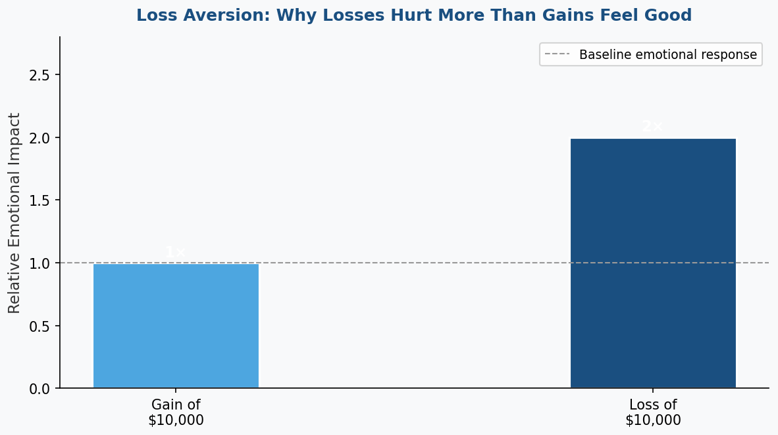
Psychologically, the pain of losing money is far greater than the pleasure of making it. Research shows that losses are felt roughly twice as strongly as gains of the same amount. So while a hypothetical loss of 10% may seem manageable in conversation, the reality of watching your portfolio shrink in value can be emotionally overwhelming.
Imagine telling yourself that a 15% dip is no big deal when the market is up. But when that same dip occurs and your $500,000 nest egg is suddenly worth $425,000, it feels a lot more serious. The fear of further losses can lead to impulsive selling, locking in those losses rather than waiting for a rebound.
Recency Bias
People often give more weight to recent events, assuming that what just happened will continue. When the market is soaring, you may feel more comfortable taking on additional risk. But when the market suddenly shifts, recency bias can turn your confidence into panic, making you feel as though the losses will never stop.
After a few years of strong returns, investors tend to underestimate risk, forgetting the pain of previous downturns like the 2008 financial crisis. When the 2020 pandemic crash hit, many investors were caught off guard, despite knowing from past experience that downturns are a natural part of market cycles.
Herd Mentality
When markets get turbulent and the media is filled with alarming headlines, it is natural to feel the urge to follow the crowd and sell off investments like everyone else. This herd mentality can cause people to deviate from their long-term strategies, amplifying short-term fear over long-term planning.
During the 2008 financial crisis, many investors sold at the bottom, fearing that things would only get worse. By the time the market recovered, they had already exited, missing out on significant gains.
Actionable Steps to Determine and Manage Your Risk Tolerance
• Take a comprehensive risk assessment: Look for assessments that go beyond how you feel about losses in theory. Consider your financial situation, goals, and past reactions to market downturns.
• Evaluate past behavior during market declines: Think back to events like the 2008 financial crisis or the 2020 pandemic crash. How did you feel? Did you want to sell? Your reaction to these moments can be a better gauge of your true risk tolerance than hypothetical scenarios.
• Start conservatively and adjust as you gain experience: If you are new to investing, it can be helpful to start with a more conservative portfolio and gradually adjust your asset allocation as you become more comfortable with market fluctuations.
• Consider your time horizon and financial goals: If your goals are short-term, you will likely want to be more conservative. For long-term goals like retirement, you can afford to take on more risk, knowing you have time to recover from downturns.
• Work with a fee-only financial planner: A financial planner can help you understand your risk tolerance, align it with your goals, and build a portfolio that reflects your true comfort level while providing guidance during turbulent markets.
Bringing It All Together
Understanding your risk tolerance is more than just filling out a questionnaire. It is about preparing for how you will actually feel and react when the markets turn volatile. Most investors are more conservative than they think, especially when faced with real losses. That is why building an investment strategy that aligns with your true tolerance is key to long-term success.
A well-defined risk tolerance, paired with a personalized financial plan, allows you to stay the course and achieve your financial goals, even when the ride gets bumpy. At KLD Wealth Management, this conversation is central to every client relationship.
The goal is not to eliminate volatility. It is to build a portfolio that matches your real risk tolerance so you never feel pressured to make a decision you will regret.